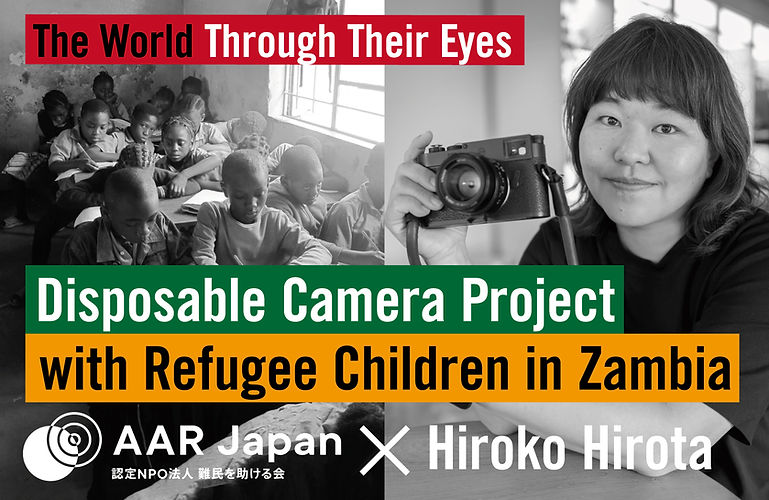
Introduction
Hello, my name is Hiroko Hirota, and I am a photographer based in Japan.Over the years, I have photographed people and everyday life in Central Asia, India, and Southeast Asia. Wherever I went, I found something important: even in places that others might describe only through poverty or hardship, people were still laughing, playing, loving, and living their lives.
This is my first experience to visit Africa,
I am excited to meet new people and see new places.
This project began with a question:Are refugee children really only “poor” or “pitiful”?When we see images of refugees in the news, many of us unconsciously view them through a filter of sympathy.
But is that the whole truth?
Or are we only seeing what we expect to see?
Some time ago, two people looked at the same photograph I had taken in India.
One person smiled and said,“India has become so much richer.”
The other looked at the same image and said with tears,“How sad… those children look so poor.”
I was shocked.The photograph itself had not changed.What changed was the filter through which it was seen.That moment stayed with me.
It made me wonder:What would happen if we could remove our filter, even for a moment?
What would happen if refugee children could show us their own world, with their own eyes?
That is why I created this project.
About the Project
Through this project, children living in the Meheba refugee settlement in northwestern Zambia will be given disposable cameras.Instead of being photographed by others, they will become the photographers.They will capture what matters to them:
their families
their friends
their daily lives
their favorite places
things they love and want to remember
I will photograph alongside them, but the most important images will be the ones they take themselves.
The films will be brought back to Japan, developed, and presented in a photo exhibition on June 20, 2026 — World Refugee Day in Tokyo.
Why Disposable Cameras?
This project uses disposable film cameras instead of digital cameras for two important reasons.
First, they are simple.Digital cameras require charging, battery management, and data storage. Images can also be accidentally deleted.
Disposable cameras are easy to use, even for children, and let them focus only on seeing and photographing.
Second, film changes the way we look.
With a limited number of shots, every frame becomes precious. Children must pause, choose, and press the shutter with intention. And because the images cannot be seen immediately, there is also a beautiful sense of waiting — of not knowing exactly what has been captured until the film is developed.That waiting is part of the magic of photography.
What This Project Hopes to ShareThis is not a project that turns refugee children into objects of pity.This is a project that allows them to become the ones who look, choose, and tell.They are not just subjects in front of a camera.They are photographers.
They are witnesses to their own lives.They are children with their own humor, affection, curiosity, memories, and beauty.I want to bring the world they see to Japan — not the world we imagine for them, but the world they actually live in.Perhaps their photographs will surprise us.Perhaps they will challenge our assumptions.Perhaps they will show us joy where we expected only sadness.And perhaps, by seeing through their eyes, we can learn to see more honestly ourselves.
How the Funds Will Be Used
Your support will help make this project possible.
Travel expenses to Zambia
(Tokyo–Lusaka flights, domestic transportation, accommodation, local travel, etc.)
Approx. ¥500,000
50 disposable cameras and film development costs
(Approx. ¥2,800 + ¥2500 × 50)
Approx. ¥265,000
Exhibition expenses in Tokyo(prints, panel production, display costs, etc.)
Approx. ¥300,000
Total Approx. ¥1,100,000
Schedule
Mid-May 2026 Hiroko Hirota Travel to Zambia and carry out the photography project
June 20, 2026 — World Refugee DayPhoto exhibition in Tokyo (planned in Shibuya)
Final Message
To be honest, there are uncertainties.Will the children be able to use the cameras well?Will all the cameras come back safely?Will the photographs turn out the way we hope?
I have no idea what result will be.But that is also why this project matters.
With this project, we may see something we have never seen before
:the world as refugee children see it, in their own images, through their own hands.
Not images made about them.Images made by them.
And if many powerful photographs emerge, I hope this project can grow into a photo book as well, so that their voices and visions can travel even further.
I would be deeply grateful for your support in helping bring these children’s perspectives into the world.
Thank you for your interest and your help my dream come true.